Loss or Lagnappe?

Spring has come to OklahomaSpring has come to Oklahoma.  Sunny, longer, breezy days.  Okay the days are sunny, longer, and windy, but springlike nevertheless.  In the warmth of the sun we could almost forget the recent blasts of winter. Who wouldn’t want to forget?  After all, Snowmageddon  followed by Snowpocalyse paralyzed our state resulting in significant loss.  People lost power and income. Their property was damaged and their lives were compromised.  But what if there are things worth remembering?  Things that weren’t lost, but gained?

The word “Lagniappe” came into the rich Creole dialect of New Orleans around 1849, and is still used in the Gulf states, especially southern Louisiana. “Lagniappe” is a little bonus that a friendly shopkeeper might add to a purchase. It has been broadened to mean “an extra or unexpected gift or benefit”.

As the first week of the 2011 “blizzard” passed, I began to find “unexpected gifts” scattered in conversation, facebook entries, and my own experience. By the time roads began to clear I had witnessed the “unexpected gifts” of people spending time in the kitchen baking bread, making potato soup, cooking comfort food together, and recreating childhood food favorites.  As days passed I read facebook entries of families sitting at the dinner table eating home cooked meals, talking and laughing together.

Lagniappe!

We gathered around fireplaces to play games, tell stories, and cook smores. We helped shovel porches and driveways.  Grownups and children had snowball fights, made snow angels,  and went sledding. We worked, played, and connected as families, friends, community.

Lagniappe!

What could be better than the “benefit” of the winter lagniappe of 2011? Perhaps gathering around the table with people we love, for a home cooked meal, followed by an evening of playing games together.  Not because we’re trapped at home by a winter snowstorm, but because we chose to give and receive the “unexpected gift” of purposeful connection.

Lagniappe indeed!

He had a dream.

This day of remembering Martin Luther King, Jr. has stirred memories of my own “growing up” before, during, and since the civil rights movement.  It surprises me when I remember that every school I attended from first grade until I graduated from high school in 1967, was segregated.  College was my first experience of getting to learn with people of color.  The diversity was not as balanced as it should have been, but at least it was present.

Fortunately for me, I had other opportunities during childhood to cross the lines of color that were so clearly drawn at that time.  My earliest memory of an influential African-American in my life came before I started school.  My dad went into business for himself, opening a full service gas station.  His only employee was a black man that everyone called Bourbon.  I loved to watch him as he worked.  I loved drinking a cold bottle of Grapette pop from the vending machine while listening to him tell stories and laugh.  When he laughed I laughed, and all seemed right with the world.

There was a family owned restaurant next to my dad’s station.  We ate there a lot.  Bourbon did too.  We ate in the front, Bourbon in the back, with the other black folks.  That back room is permanently engrained in my memory.  We walked through the “colored” room to get to the front.  Who knows how many times I passed Bourbon sitting in his room while on my way to mine.  I wasn’t more than four years old and even then I knew that arrangement wasn’t right, didn’t make sense, and I felt embarrassed that I was a part of it.

Then there was Eddy, my grandfather’s only ranch hand.  When at my grandparents I worked beside Eddy, feeding cattle, herding cattle, and listening to he and my grandfather talk cattle.  There wasn’t a “colored” dining room at the Lazy A.  Eddy sat at my grandparent’s kitchen table with us when he ate.

Martin Luther King, Jr. had a dream. . .

“that my four little children will one day live in a nation where they will not be judged by the color of their skin but by the content of their character.”

He spoke those words in August, 1963.  In December, 1960, I went with my best friend and her mother to the annual Christmas parade in downtown Tulsa.  I was in the 6th grade, full of untested opinions about how the world should operate in regard to color.  The streets were crowded with families standing in the cold waiting to be ushered in to the holiday season.  As the parade began to pass I became aware of a young woman standing beside me.  She had two little girls with her, maybe three years old and much too short to see over the crowd.  She held one for a while, then the other, back and forth, up and down.  It didn’t seem like a huge gesture, just a sensible one as I asked if I could hold one of the girl’s while she held the other so both could see.

The parade ended.  The young woman thanked me again.  I said good-bye to the little girls.  I didn’t think I had taken a stand across the color line.  I just knew how much fun it had been to enjoy the parade through the eyes of children.  The fun ended when we returned to my friend’s house and sat down at the kitchen table to eat.  They began to make jokes about what I had done as though it was inconceivable that a white person would do such a thing, and that I must be uninformed or stupid for having chosen to help.  I can still recall the sickening, angry feeling that my “best” friend was behaving this way and her parents, adults I trusted, were encouraging her by participating in the teasing.  I was glad to get back home to the safety and freedom of my own family’s kindness and acceptance.

I look back on that experience and am reminded that it is often the children who take the first step toward good.  I was a child then.  It was years later before I defined my actions as courageous.  At the time I just thought of them as right.  There is a child nearby willing to be kind, willing to see something beautiful in others, willing to step toward what is right.  That child is also watching you.  When the first, courageous step is taken, let’s make sure we’re not standing in the way.

“The arc of the moral universe is long, but it bends toward justice.”  MLK

Thank you Dr. King.

More than you’ll ever know.

Trivia is intriguing.  Trivia couched in a story becomes less trivial and more about “fleshing out” a person or situation.  I knew Brian May played lead guitar for Queen.  I didn’t know he also held a PhD in astrophysics.  I discovered that piece of trivia listening to the story of how in 2007, a Dutch school teacher discovered “a great, green blob floating in space”.  She knew very little about astronomy but while looking on Brian May’s website, followed a link to Galaxy Zoo photos, where she made the discovery.

What interests me about this bit of trivia has nothing to do with astronomy and very little to do with Brian May.  It has to with drawing conclusions based on partial information, making assumptions.  The moment I learned that Brian May has a PhD in astrophysics I realized “again” how often I assume that all I know about a person is all there is to know.  I thought of how easy it is to forget that people have a history of experiences and stories that precedes my stepping into their lives, and how that view may limit my definition of who they are.

Marie Hughes was one of the sweetest people I have ever known.  She seemed almost too nice to be real.  I knew Marie had been married for a long time to Luther, a gentle, pleasant man in spite of having been a POW during the Vietnam war.  Over time I think I began to assume that only someone incredibly innocent could be that sweet, a 20th century Pollyanna.  If Marie had reached her senior years with innocence intact, then I had to conclude she hadn’t felt the “slings and arrows of outrageous fortune”.  I think I began to see Marie as sweet, and diminished.

I was facilitating a women’s book discussion group which Marie attended regularly.  One night the discussion focused on how we live in spite of difficult life experiences and loss.  That night I learned how much I didn’t know about Marie Hughes as she told us about her first husband, a railroad worker who was killed on the job, leaving her a young, widowed bride.  She described her devastation and grief, how empty and lost she felt, how she didn’t think she could go on.  She told us how her father’s strength helped her and what a godsend it had been when she met Luther and they began to build a life together.  I was stunned. Marie was still one the sweetest people I had ever known, but she was no longer untested, and she would never be diminished to me again.

Tracy Kidder wrote about life in a nursing home in his novel, Old Friends.  It is a wonderful, insightful story of strangers becoming community, of people near the end of life whose history and stories seem present in fragments if at all.  Kidder borrows a line from a Frost poem as he wonders, “What to make of a diminished thing…”  After the revelation about Marie, I began to look at the people around me wondering how many of them I had diminished simply because I didn’t know more of their story. How many had I discounted without intending to, due to my tunnel vision about who they were, what they had accomplished, and what they had to contribute.  I became more aware of the risk of living out of my own perception without acknowledging the inherent limitations.

I could suggest that we focus on gathering every tidbit of information we can about those we encounter.  Although there are occasions when we should be open to a fuller life story, it isn’t practical to think we can literally know everything about someone before we assess who they will be to us or who will be to them.  What I am suggesting is that we work to be fully aware that there will always be more to the story than we will ever know. That our respective stories will be a part of our exchange even when we don’t know they’re there.  And knowing that, we will add an extra measure of grace to our giving and our taking.

I think Plato said it well…

“Be kind for everyone you meet is fighting a hard battle.”

But that’s not what I meant. . .

I am disturbed in several ways by the tragic events in Tucson.  I’m reminded of life’s fragility, our vulnerability, and the power, for good or bad, of our connections.  What I have thought about most however is something much more subtle and pervasive.  The power of language.

Much of the discussion following the shootings has focused on our climate of caustic language.  The subtle, and not so subtle use of words that demean, attack, accuse, mislead, and stir up.  Many of the responses can be summed up with the statement, “That’s not what I intended.”

Thinking about the mix of intention and language took me back to my earliest days working in an adult day treatment program for individuals with severe mental illness.  I grew to have tremendous regard and appreciation for the people living life on a landscape of mental illness.  They will never know the power of the lessons I learned during our time together.  One of  the most powerful came randomly in the course of the daily activities.

A co-worker and I had been bantering back and forth during the noon meal.  She tossed a sarcastic comment my way and I responded by laughing and saying, “I’m gonna have to kill ya now.”  We laughed at the running joke, continued lunch, and our conversation.  What I didn’t know was that one of the clients walking by the table had heard my “threat” to my colleague, and took the words and my intention as exactly what I had said.  Fortunately the client expressed concern to my colleague and we had the chance to clarify the meaning behind the words.  I believe it is also fortunate that my experience often comes to mind to remind me of the power of the words I speak, the power of their impact when heard by others, and how their meaning can change during that process.

Wayne Dyer wrote a book titled The Power of Intention.  I would like to expand that title to “The Power of Intention Expressed.” The best of intentions poorly expressed, or poorly heard, can have hurtful consequences.  It is important to think before we speak, to think about how we speak, and to think about how our words may be heard and felt by others, those we know are listening and those we don’t know at all.

I would love to say that since that early error in judgement, all of my intentions have been spoken appropriately and without harm.  The bad news is I have had other opportunities to learn the lesson “again”.  The good news is the “lessons” urge me to think before I speak and to be sensitive to how my words land on those around me.

May we choose our words carefully in discussion and debate.  May we speak words of clarity, respect, encouragement, and kindness to our family, friends, colleagues, our advocates, and perhaps especially to our adversaries.

Turning the day RED

Today, December 1st, is World AIDS Day.  For years the symbol of a single red ribbon has called us to care, and to act.  In 1996, I completed my master’s thesis on the impact of  individuals disclosing to their family that they were HIV positive. During my research I interviewed people diagnosed with HIV or AIDS and in various stages of their journey with a terminal illness.  My time spent hearing their stories was life changing.

I discovered individuals living with courage in the face of a disease that isolated and ostracized.  I discovered many families rising up with compassion and integrity to surround their loved one with their presence.  In spite of the stigma, the known and the unknown, the agony of watching their child, sibling, parent, spouse, friend waste away before their eyes. . .they stayed, and they loved.

I discovered the power of numbers to tell us, “Somebody should do something.”.  I discovered the power of names and faces that told me, “I must do something.”.

A lot has changed in the 15 years since I heard those stories.  Too many have died.  Medicine has helped the battle be more chronic and less terminal.  We’ve gotten smarter and better at prevention.

What hasn’t changed?

  • We are still at risk of letting stigma and ignorance blind us to the names and faces of the individuals and families living with AIDS.
  • We are still at risk of believing HIV/AIDS is not our problem.
  • We are still at risk of robbing ourselves of the gift of courageous stories in exchange for our compassion and action.

We all know someone who has been affected by HIV/AIDS. . .even if we don’t know who they are.  My hope is this is the day we choose to be the eyes and ears of compassion in all our encounters, to those whose wounds are obvious, and to those whose wounds we can’t see.  After all, we are all walking wounded.


Living from a position of gratitude

The day after Thanksgiving, Garrison Keillor introduced the Writer’s Almanac poem of the day, 25th High School Reunion by Linda Pastan.  Then he began to read…

We come to hear the endings
of all the stories
in our anthology
of false starts:
how the girl who seemed
as hard as nails
was hammered
into shape;
how the athletes ran
out of races;
how under the skin
our skulls rise
to the surface
like rocks in the bed
of a drying stream.
Look! We have all
turned into
ourselves.

I followed the reading, chuckling at the poet’s description of the all too familiar “reunion” experience.  I chuckled right up to the last line which suddenly filled me with so much more than humor.

“Look! We have all
turned into
ourselves.”

I began to think about the youth crazed standard we use to measure ourselves.  How we begin to mourn our lost youth and apologize for our changing bodies by the ripe old age of 30.  How quickly we begin to refer to what we can’t do anymore now that we’re “getting older.”

It’s possible that the poet intended a totally tongue in cheek picture of coming face to face with our aging selves.  But what if she meant to catch us off guard at the end by suggesting that it is a good thing at any age to be able to say, “Look!  We have turned into ourselves.”?  What if the point is to recognize and celebrate ourselves…25 years later?

The day after Thanksgiving I heard this poem.  It made me chuckle.  It also reminded me that at 61, I’m still “turning into myself”.  I wonder if deciding to be grateful for each additional year of “turning” adds a healthy glow to our face or puts a little spring in our step.

Turn into your best self today.  Live from a position of gratitude.

“I see who you are…”

There are kids who won’t settle for anything less than connection from the adults in their lives.  As annoying as that may be, it’s a good thing.  They press us to be who we should be, the grownups in their lives who guide them, invest in them, and in our finer moments delight in them.  Maybe we shouldn’t wait to be pressed.

I listened recently to an interview with Debbie Boone as she talked about her mother-in-law, Rosemary Clooney.  The Interviewer asked what kind of grandmother Rosemary was to her four grandchildren.  Debbie’s immediate and emphatic response, ” Oh she absolutely delighted in them!”.  She went on to describe the ritual of Rosemary sitting in a large chair in her den.   As her grandkids entered the room she exclaimed, “My babies,” which was the kids signal to climb in the chair for hugs.

It’s a Norman Rockwell print isn’t it?  Connecting with persistent, delightful kids.  But what about delighting in kids who aren’t persistent or delightful?  What about children whose behavior is difficult and repulsive?  What of the kids who withdraw?  Or those who  openly reject our gestures when we do make an attempt to connect, and maybe even “take delight”?  In our finer moments we look past the resistance to find something we can delight in.

Erin Gruwell is a great example of looking past a child’s surface to the possibility of delight.  She began her career teaching English to a volatile mix of low achieving 9th graders in a Long Beach, CA high school.  The amazing story of transformation was captured in the book, Freedom Writer’s Diary, and the movie that followed.  It is a story of choosing to see possibility and hope when there is no logical reason, or past evidence to believe that either exists.

Andre is one of Miss Gruwell’s students.  Early in the film we see him at his home in the projects.  His mother’s laying on the couch staring into space.  Andre is leaving to go on a field trip with his class, a first for most of them.  We hear his voice narrating his story.

“Since my pops split, my mom can’t even look at me ‘cause I look like my dad.  And with  my brother in jail, she looks at me and thinks that’s where I’m going too.  She doesn’t see me.  She doesn’t see me at all.”

Later in the movie, Andre, who has been working hard in school, becomes discouraged by his family circumstances and begins to skip class.  One day Miss Gruwell catches him in the hall, asking where he has been.  As their conversation continues, she says,

“I see who you are.  Do you understand me?  I can see you and you are not failing!”

A single tear rolls down Andre’s face and we know he feels seen.  Connection has been made, and maybe for the first time, Andre feels the “delight” of an adult.

Maybe this true story is the exception.  Maybe Erin Gruwell is special and her students were just waiting for someone to invest in them.  But what if the only thing that could make this story an exception is our failure to grow into grownups who find a way to see the possibility in every child and believe it into existence.  Chances are a child who needs to be seen will cross your path today.  I hope you’ll be looking past the surface to see.

“Do you see me?”

Walking the dog, long overdue.   Him zigzagging, sniffing, checking for changes on our path or the scent of some other “four-legger” and human who thought this route belonged to them.   I was not that purposeful.   In fact I was avoiding anything more taxing than the vague awareness that my feet were moving me forward.

“Nice dog!”.  The voice came out of the air above me.   I stopped, looked up, saw nothing but sky and the tree I had just walked under.   I spoke a “Thank you” back into the air, took a few steps and heard, “I’m up here!”.   Of course I had to go back for another, more purposeful look.   “Do you see me?”  This time I strained to see something other than leaves and limbs in the tree above me.  Still nothing but the voice giving me another hint, “I’m way up high!”.  Obviously it would not be okay with either of us for me to move on until I had spotted the body that contained this persistent voice.

Finally I saw the boy way up in the tree, camouflaged by leaves.  “You are way up there”, I said.  I made myself not say, “I hope you don’t fall!”.   I guess I didn’t want to turn his proud moment into the Red Ryder BB gun warnings given to Ralphie in Christmas Story.

I said “Goodbye,” and continued my walk.   After placating my “mother voice” in my head with a few repetitions of “I hope he doesn’t fall.”, I began to think about the other “meanings” of this exchange.   Without a doubt this boy wanted to connect.   He wanted to be heard and seen, and he was going to persist until he succeeded.   The wild card in his plan was me.   I had to choose to keep looking for him.  I had to be willing to hear the clues that would guide me to him.

Thankfully I persisted.  After all I had nothing “better”, more pressing to do.   But what if I had been in a hurry or had important business to tend to?   I would have missed the opportunity in that moment to be the grownup who accepted the invitation from a child to connect.  That would have been my loss as well as his.

More on “seeing” children in the next GrowthLines post…

Just a piece of paper. . .

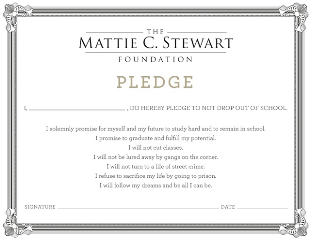
I stepped into the seventh grade literature class to watch and discuss scenes from the movie “Freedom Writers”.  A boy greeted me with “I know you!”  I smiled, thinking of the time spent over the years with students at SMS.  I assumed he remembered me from another class, the hallways, or at some school event.  He said, “You talked to my grandparents.  You gave them a piece of paper for me to sign.  I signed it and it’s in a frame on my bedroom wall.  It’s my promise to stay in school and to not do drugs or join a gang.”

It took me a minute to shift gears and realize his grandparents must have come to a parent involvement night when he was a fifth grader.  We had watched “InsideOut”, a documentary about the epidemic of school drop outs and the value of staying in school.  The parents were given certificates to take home to their children.  They were encouraged to talk with their kids about their education, asking their fifth graders to “contract” with them to choose school instead of dropping out.

Positive outcomes are always good news.  Coming from a seventh grade boy made it even more special.  As I replayed the scene throughout the day, I began to think less about my part in the outcome and more about the power of a piece of paper.  For two years a piece of paper hanging on a boy’s wall had reminded him of his grandparent’s commitment to him and their investment in his future.  That framed piece of paper was their celebration of his commitment displayed in a prominent place.  It was a subtle, daily message that they expected him to keep his part of the bargain.  A paper statement of their belief in him.  And he clearly got it.  Just a piece of paper, printed in bulk from my computer, handed out to multiple fifth grade parents.  Just a piece of paper, turned into so much more by grandparents and a grandson who believe in possibility.

My youngest daughter created a time capsule in a shoebox as an eighth grade science assignment.  She spent several days filling her box with bits and pieces of her life.  I didn’t know the contents of her time capsule until ten years later when the science teacher, now administrator, brought my daughter’s box to me.  I raised the lid for a walk down memory lane through the keepsakes chosen by my daughter to represent her eighth grade life.

There were snapshots, trinkets, movie tickets, drawings, and pieces of paper…post it notes…from me, dropped in a lunch bag, stuck in the front of a binder.  Notes that said, “I love you”, “Have a great day!”, “I’m proud of you.”.  Pieces of paper that an eighth grade daughter chose to keep at a time when becoming a person separate from her mother was part of her job.

Remember the MasterCard commercials that listed items one at a time followed by their price tag.  Then the resonant voice read the last thing on the list, usually something involving human connection.  After a pause for effect, the voice said, “Priceless.” The commercial reminded us the value of some things goes way beyond a dollar amount on a price tag.

Sometimes a piece of paper is just a piece of paper.  Sometimes a piece of paper is a relationship, a child’s drawing hung with a magnet on the refrigerator door, a reading award, a “have a great day” post it note in a lunch sack, or a boy’s signature on a certificate that says “I will stay in school”.  That’s when a piece of paper becomes. . . “Priceless”.  Create a priceless relationship moment in someone’s life today.  All it takes is a piece of paper.

Coming Home

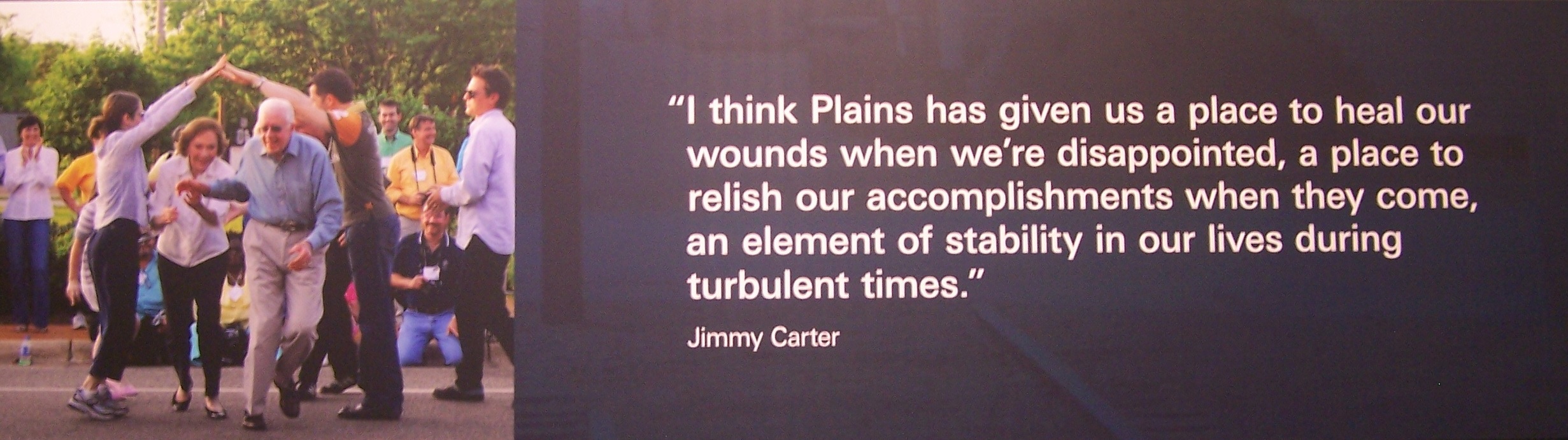
I recently visited the Jimmy Carter Center while attending a conference in Atlanta.  I like Presidential libraries because they belong to all of us.  As I walked through the Carter Museum, I looked at photos, read quotes, watched film footage, and listened to archived radio broadcasts of our collective history framed in the years of one man’s presidency.  There were accounts of times when we fell short of our best, and times we rose above ourselves to a higher level of integrity.

As I neared the end of the exhibit, one photograph and quote caught my attention.  It captured a moment in one man’s story and gave us a powerful definition of home.

We all need what the Carters found when they came home to Plains, GA.  We all need a place to heal, a place to celebrate, and a place that will anchor us in a storm.  The Carters came “home” to a place, a house, a community, but I don’t think home was limited to a physical place for them.  Perhaps coming to Plains reminded them that we can create “home” within ourselves, in our connection to each other, in our family’s history, and in our passion to leave our mark on this world.

Where is “home” for you?  Are you using those outside places and inside spaces for renewal, recognition, and shelter?  Are you offering “home” to others?  I’m glad the Carters found all those things when they returned to Plains.  I’m grateful for their commitment to join with others to create “home” for so many in our world.