The language of loss

There are a handful of books in my library that I decided to buy before I knew much about the contents, because the title was intriguing.  One of those is Steve DeShazer’s Words Were Originally Magic.  I thought of the title again when I decided to write about “the language of loss”.  I discovered that DeShazer’s title was inspired by these words.

“Words were originally magic and to this day words have retained much of their ancient magical power. By words one person can make another blissfully happy or drive him to despair.”     Sigmund Freud

I don’t know that the language of loss is magical, but it is powerful.  It has the power to heal, to offer respite, to comfort.  It also has the power to confuse, to limit, and at its worst to harm.  Language is at the center of the things we tell ourselves, how we think out loud with others, how we experience this life. The words and phrases we use are like the weft and warp on a loom that determine the pattern and texture of the fabric.  I wonder how the fabric of our grief might look if we wove it with a different language.  Would it comfort us to know that our experience and expression of grief is not a sign of craziness, but a richly woven fabric of our common journey?

I have sat with many people over the years in moments of grief, but I can only speak with certainty from my own.  I can’t say “closure” or “saying good-bye” are a help to me if they mean I will come to an end of grief, that I will be done with who I lost.  If my job in grieving is to finish, and to finish means to end the relationship,…well, I’m going to avoid that finish line at all costs.  I have no intention of being done with those I’ve lost.  But what if our relationships are not bound by time and space.  What if our grief is not about the end of relationship, but about how relationships change when death comes.

In the movie Shenandoah, Charlie Anderson, played by Jimmy Stewart, is a widower trying to keep family and home together in the midst of the Civil War.  Charlie often visits the family gravesite to talk with his dead wife Martha.  He tells her about the children and the war.  He asks her questions and shares his thoughts.  These private, intimate moments between Charlie and Martha assure us that our relationships continue beyond death.  In the midst of the sadness and pain of loss, Charlie Anderson also finds comfort and the strength to continue.  Even in death, Martha remains his partner for the journey.

When we don’t talk about death, we are at risk of believing that our experience of death is not only unique, but may be evidence that we’re crazy.  We may worry that our ongoing involvement with our loved one means we’re “stuck” in our grief.  We may also worry about what it means when some of our memory seems to be slipping away.  Sometimes we can remember details of a person’s hands, can hear their voice, can see them moving, but their face begins to fade.  I don’t know what it means that we can often call to mind so much about someone we love, while their face becomes a blurry, veiled image.  If our eyes are windows to our soul, perhaps a face that fades in our mind is a reminder that our relationship is no longer defined by a physical body, but now fills the universe.

If we are going to discuss death, we need language.  But experiencing loss and death is not the same thing as the language we use to describe it.  Language can be concrete and limiting.  Loss continues to remind us that it will not be bound by a word.  That it is often gray and messy.  Don’t be afraid of the language of loss.  It’s the willingness to speak our loss into words that creates a language of possibility rather than limitation.

“We’re fascinated by the words–but where we meet is in the silence behind them”
                                                                                                                 -Ram Dass

The Essential Conversation

I love books.  My idea of a great time is going from section to section in a bookstore, the bigger the better, looking for titles and covers that spark my curiosity or speak to an interest or need.  I have been known to buy a book because a title caught my eye and I trusted the contents to be just as interesting.  “The ESSENTIAL Conversation:  What Parents and Teachers Can Learn From Each Other”, by sociologist, teacher, and parent, Sara Lawrence-Lightfoot was one of my best “title” purchases.  If the title hadn’t caught me, the introduction would have sold the book.  The author wrote:

I believe that for parents there is no more dreaded moment, no arena where they feel more exposed than at the ritual conferences that are typically scheduled twice a year–once in the fall and once in the spring–in schools. . . it is also the arena in which they [teachers] feel most uncertain, exposed, and defensive, and the place where they feel their competence and professionalism most directly challenged.”

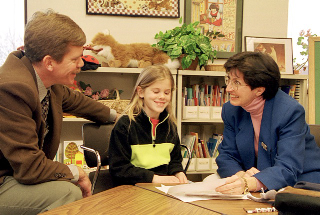
After a quick read, the book went on a shelf until a few months ago.  As school came to a close I thought back over nine months of encounters with students, parents, and teachers.  I explored ways to make those times more helpful, more effective.  I found myself thinking of how our interactions as parents and teachers are occasionally like angry ex spouses, anxious and defensive.  We know that children often get lost and compromised in the crossfire of divorce.  I began wondering how often children are also hurt by our failure to work together as families and schools, parents and teachers.

Parents and teachers are two tremendous resources with the power to impact our children and society.  The times I have watched adults step past their anxiety and uncertainty to talk to each other in a parent/teacher conference in order to help a child succeed in school have excited me. Unfortunately we often avoid the encounter completely.   Or we approach our meeting as adversaries, becoming defensive and territorial in ways that rob us of the very thing we want, to be a part of preparing our children for a healthy, successful adulthood.

I thought of “The ESSENTIAL Conversation”, and what an appropriate, meaningful title it is.  I pulled the book off the shelf and began to read again, more thoughtfully this time.  I reviewed my own school experience trying to imagine my parent’s “conversations” with teachers.  I recalled sitting in the parent chair across from teachers as we discussed my children’s performance and progress.  I wondered if both the teachers and I were worried that we would be “blamed” for the problems and would have to give up all credit for the successes.  I took some comfort in Lawrence-Lightfoot’s thoughts:

“From my point of view there is no more complex and tender geography than the borderlands between families and schools.”

“. . . my own hard-earned wisdom as an educator and social scientist concerned about these matters did not prepare me for the depth of emotion and drama I felt in parent conferences.”   “I always suspected that other parents were experiencing some version of my anguish, but that they too were struggling alone and making it up as they went along.”

“I could also tell that teachers had their own deep concerns,  their own sense of exposure and vulnerability.  And I knew that most of them had not been adequately prepared in their professional training programs to build relationships with families as a central part of their work. . .”

We are less than one month into a new school year.  How can we take advantage of all our family/school encounters in ways that encourage our children to learn and enhance their learning environment?

Whether you are teacher, parent, or both:

  • Remember this “conversation” isn’t about you, it’s about your children.  Learn to calm your own anxiety so it doesn’t get in the way of working together.
  • Believe that sharing your observations with that other adult will allow you both to discover solutions to problems and will magnify the celebration of success.
  • Recognize each other’s efforts.  Kudos help us know we “did good” and motivate us to do more.
  • Be willing to start the conversation and to keep it going even when you disagree.  Tolerate the discomfort for growth.

For schools:

  • When you say parents are welcome at school, really mean it.
  • Encourage family involvement and look for creative ways to make that possible.

For families:

  • Be present in your child’s school experience.
  • Know their teachers and their curriculum.
  • Attend school activities.
  • Communicate with teachers in person, by phone, and in writing.

“The ESSENTIAL Conversation” considers “how the tiny drama of parent-teacher conferences is an expression of a larger cultural narrative.”  For me it is a reminder that the “tiny drama” of parent/teacher conferences isn’t so tiny after all.   You be the one that begins the conversation.